How to Increase Punching Power
How to Increase Punching Power: 5 Keys to Hit Harder
Every fighter wants to punch harder. For competitive boxers, punching power ends fights, earns respect and forces opponents to stay honest. And anyone who trains with a boxing workout, from amateur fighters to people who box for fitness, wants a punch that lands with real snap.
So the question I hear most after 25 years of coaching fighters is simple: can you actually increase punching power?
By Dominic Paris, former conditioning coach of Oscar De La Hoya
Many old-school coaches say no. Heavy hands, they argue, are something you are born with. They are half right. Speed and explosiveness are strongly influenced by genetics, and no program will turn a naturally slow athlete into a sprinter.
But punching power is not speed alone. Power is force multiplied by velocity. Force, meaning strength, is something you can build, and with the right program you will see real gains in a few months. If you get stronger while keeping your speed, you gain power. More power means a harder punch.
Speed is harder to improve, but it is possible with a very specific, well-planned training program. The problem is that most boxers and coaches never do what that requires. Here is how to punch harder in boxing, step by step.
What Punching Power Really Is
A knockout punch does not come from the arm. It starts at the floor. The legs drive into the ground, the hips and core rotate, the shoulder turns over, and the fist is simply the last link in the chain.
That is why punching power depends on three things working together:
- Strength: how much force your body can produce.
- Speed: how fast you can produce it.
- Transfer: how well coordination and accuracy deliver that force to the target.
Miss any one of these and your punch loses power. Train all three and it improves.
The Question That Explains Why Your Punch Is Not Improving
Before you change anything, answer two questions honestly:
- What percentage of your training goes to strength and speed?
- What percentage goes to endurance?
For most boxers I meet, the answer is lopsided: long roadwork, endless skipping and slow rounds make up the bulk of the week, while strength and speed get whatever time is left.
Let’s be clear. A boxing match is not a marathon. It is a series of short, explosive efforts, repeated over three-minute rounds, with brief pauses in between. If most of your training is long, steady running, you are preparing for the wrong event. Stop, and start making strength and speed your priority.
Does Running Reduce Punching Power?
Too much of the wrong endurance work can. This is physiology, not opinion.
Long, slow endurance training develops your slow-twitch fibers. When the volume is high, your fast-twitch fibers, the ones responsible for explosive power, tend to take on slower, more fatigue-resistant characteristics. Sports scientists call the broader problem the interference effect: heavy endurance volume can blunt the strength and power gains you are working for in the gym.
This does not mean you should stop conditioning. A fighter who gasses out in round four has no power at all. The key is balance. You need specific endurance, the kind that lets you repeat explosive efforts round after round. That means intervals, high-intensity rounds and repeated sprints rather than hours of jogging. The goal is explosive power you can use from the first bell to the last.
5 Keys to Increase Punching Power
1. Build Full-Body Strength and Power
You need a dedicated boxing strength training program, and it has to be full body. Every muscle group must work in coordination to create an effective punch.
Adjust the program to your needs, but in general, train in this order of priority:
- Legs first. They are the engine of the punch.
- Core second. It transfers force from the legs to the upper body.
- Upper body third. It delivers the force to the target.
Choose compound exercises that train many muscles at once. In my experience, the best exercises for punching power are kettlebell exercises. The kettlebell is a terrific tool for building total-body explosive power, because its ballistic lifts train the same powerful hip drive that powers a punch.
Kettlebell exercises for boxing worth building your program around:
- Two-hand and one-hand swings for explosive hip extension.
- Cleans and push presses to link leg drive to the upper body.
- Snatches for full-body speed and power.
- Goblet squats for leg strength.
Keep sets short and crisp. Stop each set before your speed drops. Grinding out slow reps trains slowness, which is the opposite of what you want.
2. Develop Explosive Leg Speed with Uphill Sprints
The legs are critical for total-body power, so sprint twice a week. The best option for boxers is uphill sprints.
Running uphill forces you to drive hard into the ground with every stride, which builds the explosive leg power a punch depends on. The incline also limits your top speed, which reduces strain on the hamstrings compared with flat sprinting.
A simple session: 6 to 10 sprints of 8 to 15 seconds at full effort, walking back down for recovery. Quality matters more than quantity. If your last sprints are noticeably slower, end the session.
3. Sharpen Your Accuracy
A punch that misses has no power. A punch that lands on the glove or the shoulder wastes most of its force. Accuracy is what turns power into results.
Train it deliberately:
- On the heavy bag, use visual cues: mark targets with tape and call them out, or have a partner point to them.
- On the pads, work with your trainer calling targets and combinations, so you react and hit precisely under pressure.
A precise punch to the chin, temple or liver will do more damage than a harder punch that lands off target.
4. Perfect Your Coordination and Technique
Good technique is essential, and it comes down to perfect coordination between the legs, the abs and the arms. Any break in that sequence leaks energy. A lack of coordination always means a loss of power transfer and efficiency.
To tighten your mechanics:
- Shadowbox slowly and focus on the order of the movement: foot pivot, hip rotation, shoulder turn, then the hand.
- Exhale sharply as you punch to brace your core.
- Film yourself. You will often see a leak that you cannot feel.
The smoother the chain, the more of your strength reaches the target.
5. Hit the Heavy Bag at 100 Percent, with Full Recovery
This is where many boxers go wrong. A power-focused heavy bag workout is not a cardio session.
Work in very short sets: 6 to 10 seconds, or 5 to 8 punches, thrown at close to 100 percent intensity. Early in a training cycle, take long rests of 60 to 90 seconds between sets so every set is truly maximal. As the weeks go by, you can gradually shorten the rest to build the ability to repeat powerful efforts.
Working the bag at 50 percent is useless for power. You will never punch at 50 percent in combat, so do not train that way when power is the goal. When the snap fades, the set is over.
A Sample Week to Increase Punching Power
Here is how these pieces can fit into a training week. Adjust the load to your level and fight schedule.
| Day | Focus |
|---|---|
| Monday | Kettlebell strength and power + short maximal bag sets |
| Tuesday | Technique and pad work with target calling |
| Wednesday | Uphill sprints + high-intensity conditioning rounds |
| Thursday | Kettlebell power (swings, cleans, snatches) |
| Friday | Sparring or pad work |
| Saturday | Uphill sprints + light technical shadowboxing |
| Sunday | Rest |
How Long Does It Take to Punch Harder?
With a consistent program, most boxers notice their strength improving within 8 to 12 weeks. Speed and coordination take longer, because they depend on the nervous system learning to fire faster and more efficiently. Stay patient, track your progress and keep the quality of every session high.
The Bottom Line
Can you increase punching power? Yes. It is not easy, but it is possible.
Stop training like a marathon runner. Build full-body strength with kettlebells, sprint uphill twice a week, sharpen your accuracy, perfect your coordination and hit the heavy bag at full intensity with proper recovery. Do that consistently and you will hit harder.
Want a complete, step-by-step program? My books on boxing performance, conditioning and kettlebell training lay out the exact methods I have used with world champions and professional fighters. Explore them at Knockout Coaching and start building the power your punch deserves.
You can reach me on Facebook and Twitter.
Resources:
The Fighter’s Kettlebell System:

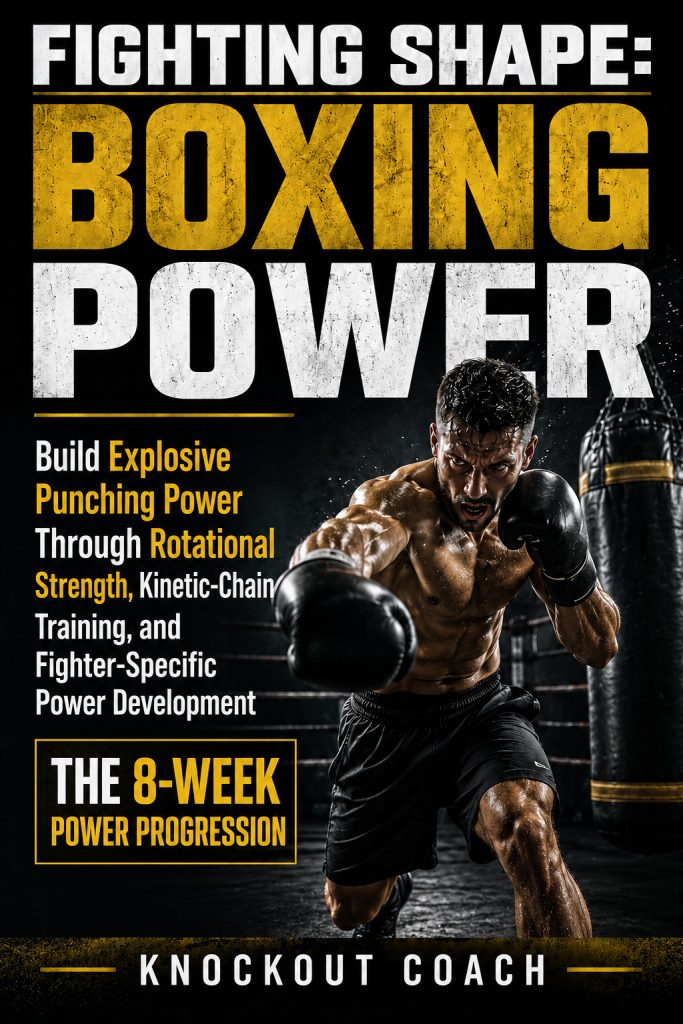
Fighting Shape: Boxing Power